



Electric Control Panel Manufacturers in India | Yashashree Techno Solutions
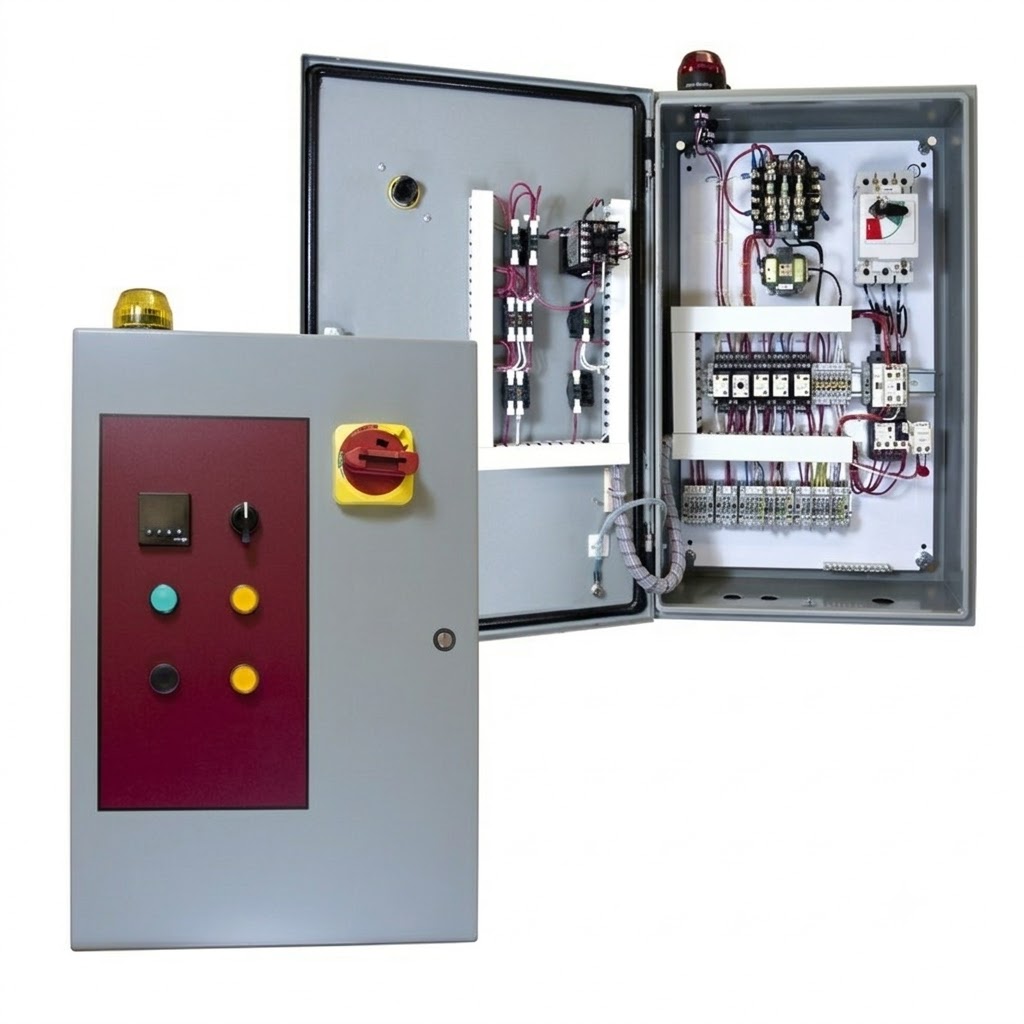


Yashashree Techno Solutions is leading Electric Control Panel Manufacturers, Suppliers and Exporters in India. An Electric Control Panel is an essential electrical system used to monitor, control, and distribute electrical power and automation functions in industrial and commercial applications. It houses electrical and electronic components in an organized enclosure for safe and efficient operation.
An electrical control panel can include circuit breakers, contactors, relays, PLCs, VFDs, HMIs, meters, switches, and other control components. The configuration depends on the machinery, process requirements, power rating, and level of automation.
Modern industrial control panels combine electrical control, instrumentation, and automation technologies to improve operational efficiency. They are widely used in manufacturing plants, process industries, machinery, utilities, infrastructure, and automated production systems.
Types of Electric Control Panels
As we are leading Electric Control Panel Manufacturers in India, our Types are designed to meet different application requirements and industry standards, including the following types:
- 1. PLC Control Panel: A PLC control panel uses a programmable logic controller to manage machines and industrial processes. It provides flexible control for automated operations and sequential processes.
- 2. HMI Control Panel: An HMI control panel provides an operator interface for monitoring and controlling machines. It displays process information, alarms, parameters, and operating conditions.
- 3. SCADA Control Panel: A SCADA control panel supports supervisory monitoring and control of industrial processes. It can be integrated with automation networks for centralized data monitoring and operation.
- 4. Motor Control Panel: A motor control panel manages the starting, stopping, protection, and operation of electric motors. It can include contactors, overload relays, starters, VFDs, and other protective devices.
- 5. VFD Control Panel: A VFD control panel uses variable frequency drives to control motor speed and operating characteristics. It is useful where adjustable motor speed and energy-efficient operation are required.
- 6. MCC Panel: An MCC panel, or Motor Control Centre panel, is designed to control and protect multiple motors from a centralized electrical assembly. It is commonly used in large industrial facilities.
- 7. PCC Panel: A Power Control Centre panel distributes and controls electrical power to different loads and equipment. It is suitable for industrial power distribution systems.
- 8. APFC Panel: An APFC panel automatically controls power factor by switching capacitor banks according to electrical load conditions. It helps manage reactive power in electrical systems.
- 9. Instrumentation Control Panel: An instrumentation control panel houses devices used for measurement, monitoring, and process control. It is commonly integrated with sensors, transmitters, controllers, and automation systems.
- 10. Process Control Panel: A process control panel is designed to monitor and control industrial processes. It can combine PLC, HMI, instrumentation, and electrical components within a centralized control system.
How an Electric Control Panel Works
- Step 1: Power Input: Electrical power enters the panel through the designated incoming supply. Protective devices such as circuit breakers and isolators provide controlled power entry and protection.
- Step 2: Power Distribution: The incoming electrical supply is distributed to individual circuits and connected equipment through busbars, breakers, contactors, or other switching components.
- Step 3: Control Signal Processing: Control signals are received from switches, sensors, instruments, or automation devices. In automated systems, a PLC processes these signals according to the programmed logic.
- Step 4: Equipment Control: Based on the control logic, the panel operates motors, valves, pumps, heaters, conveyors, and other connected equipment. VFDs and soft starters can be used for controlled motor operation.
- Step 5: Monitoring: The operator can monitor operating parameters through meters, indicators, HMIs, or SCADA systems. Important information such as current, voltage, alarms, speed, and process conditions can be displayed.
- Step 6: Protection and Safety: Protective components respond to electrical faults such as overloads, short circuits, and abnormal operating conditions. This helps protect connected equipment and improve system safety.
- Step 7: Control and Automation: The complete system can operate manually, automatically, or through a centralized automation platform depending on the application. This provides controlled and repeatable industrial operation.
Technical Specifications of Electric Control Panel
As a trusted Electric Control Panel Suppliers in India, we serve businesses across various industries that meet professional visual communication requirements.
| Specification | Typical Configuration | Components | Control System | Application |
|---|---|---|---|---|
| Panel Type | Floor-mounted / Wall-mounted | MCCB, MCB, contactors | Manual / Automatic | Industrial systems |
| Control Method | Conventional / PLC-based | Relays, PLC, HMI | PLC / HMI | Machine automation |
| Motor Control | DOL / Star-Delta / VFD | Starters, VFD, overload relay | Local / Remote | Motor applications |
| Power Distribution | PCC / LT Panel | Busbars, breakers, meters | Electrical control | Power distribution |
| Instrumentation | Process-based | Sensors, transmitters, controllers | PLC / SCADA | Process industries |
Features and Benefits of Electric Control Panel
As Electric Control Panel Exporters in India, our products provide several Features and Benefits including consistent quality, smooth finish, and long service life.
| Features | Benefits |
|---|---|
| Organized component arrangement | Makes operation and maintenance easier |
| Circuit protection devices | Helps protect equipment against electrical faults |
| PLC-based automation | Provides programmable and flexible process control |
| HMI integration | Allows convenient operator monitoring and control |
| VFD compatibility | Enables adjustable motor speed and controlled operation |
| Instrumentation integration | Supports accurate process measurement and monitoring |
| Modular design | Makes future modifications and expansion easier |
| Proper panel wiring | Improves reliability and simplifies troubleshooting |
| Remote monitoring capability | Supports centralized supervision of industrial processes |
| Industrial enclosure | Helps protect internal components from the operating environment |
Electric Control Panel Design and Engineering
Electrical Control Panel Design begins with understanding the electrical load, control requirements, connected equipment, operating environment, and applicable safety requirements. The design determines the appropriate components, enclosure arrangement, protection devices, wiring, and control architecture.
Control Panel Engineering also involves circuit development, component selection, load calculations, control logic, terminal planning, and electrical documentation. For automated applications, PLC, HMI, VFD, instrumentation, and communication requirements are incorporated into the control architecture.
A properly engineered electrical control panel system provides organized power distribution, reliable machine control, easier troubleshooting, and better integration with industrial automation systems.
Electrical Control Panel Wiring and Installation
Electrical Control Panel Wiring connects power and control components according to the approved electrical circuit design. Power circuits and control circuits are arranged systematically to simplify identification, maintenance, and troubleshooting.
Control Panel Installation includes positioning the enclosure, making cable connections, connecting field devices, grounding the panel, and completing required electrical checks. Proper instrumentation panel wiring is particularly important in process applications where accurate signals are required from sensors and transmitters.
Professional control panel wiring services help ensure that internal connections, terminals, cable routing, labeling, and component arrangements are completed according to the intended design.
Electrical Control Panel Testing and Commissioning
Before an electrical control panel is placed into operation, appropriate testing is performed to verify its electrical and functional condition. This may include checking wiring, continuity, insulation, protection devices, control signals, and component operation.
Electrical Control Panel Testing also verifies that control circuits respond correctly to switches, sensors, PLC commands, and other inputs. For automated systems, individual functions can be tested before complete process operation.
Control Panel Commissioning involves integrating the panel with connected machinery and field equipment. The system is operated under controlled conditions to verify that the electrical, automation, and instrumentation functions work as intended.
Applications of Electric Control Panel
As Electric Control Panel Exporters in India, our all types are used in various types of industrial sectors such as:
- Manufacturing Plants: Industrial control panels operate and monitor machinery, production lines, conveyors, pumps, and other manufacturing equipment.
- Process Industries: Chemical, pharmaceutical, food, and other process industries use process control panels for monitoring and controlling production parameters.
- Water and Wastewater Treatment: Control panels operate pumps, motors, valves, level systems, and treatment equipment in water and wastewater facilities.
- HVAC Systems: Electrical control panels manage motors, pumps, fans, compressors, and other HVAC equipment while supporting automated operation.
- Material Handling: Conveyors, elevators, feeders, and automated handling equipment can be controlled through PLC and motor control panels.
- Power Distribution: PCC, MCC, LT, and electrical distribution panels help distribute and control electrical power across industrial facilities.
- Packaging Machinery: Automation panels control sensors, motors, drives, pneumatic systems, and sequencing functions in automated packaging machines.
- Cement and Mining Plants: Heavy-duty industrial control panels are used to operate motors, conveyors, crushers, feeders, and process equipment.
- Food Processing: Process automation panels help control production equipment while monitoring operating parameters and machine sequences.
- Industrial Automation: PLC control panels, HMI systems, and SCADA control panels provide centralized control and monitoring for automated industrial processes.
Control Panel Components
An Electric Control Panel can contain different components depending on its application and design. Common electrical control panel components include:
- MCCB and MCB
- Contactors and overload relays
- PLC and I/O modules
- HMI
- VFD and soft starters
- Relays and timers
- Power supplies
- Terminal blocks
- Busbars
- Push buttons and selector switches
- Indicator lamps
- Digital meters
- Control transformers
- Communication modules
Proper component selection is important for achieving reliable operation and maintaining compatibility between electrical, automation, and instrumentation systems.
Why Choose Us?
As one of the leading Electric Control Panel Manufacturers in India, we deliver premium-quality solutions designed to meet diverse industrial requirements. Here's why we stand out:
- Application-Based Panel Solutions: We develop control panel solutions according to the electrical, automation, motor control, and process requirements of each application.
- Engineering Expertise: Our approach covers electrical design, circuit development, component selection, wiring, testing, and commissioning for different industrial requirements.
- Automation Integration: We can integrate PLC, HMI, VFD, instrumentation, and other automation technologies into suitable control architectures.
- Quality-Focused Construction: We focus on organized component placement, proper wiring, labeling, protection, and systematic panel assembly for dependable operation.
- Technical Support: Our team can provide assistance related to panel selection, installation, testing, commissioning, maintenance, and application requirements.
Yashashree Techno Solutions is leading Electric Control Panel Manufacturers, Suppliers and Exporters in India. An Electric Control Panel provides a centralized solution for electrical power distribution, equipment protection, machine control, process monitoring, and industrial automation. From basic motor starter panels to advanced PLC, HMI, SCADA, MCC, PCC, VFD, and instrumentation systems, control panels can be configured according to specific operational requirements. A properly designed industrial electrical control panel improves equipment control, simplifies monitoring, supports automation, and provides organized access to essential electrical components. With suitable Control Panel Engineering, Electrical Control Panel Wiring, Testing, Installation, and Commissioning, industries can establish dependable electrical and automation systems for their operations.
FAQ’s
An Electric Control Panel is an enclosure containing electrical and control components used to distribute power, protect equipment, and control machines or industrial processes.
Common components include circuit breakers, contactors, relays, PLCs, HMIs, VFDs, meters, terminal blocks, power supplies, and control switches.
A PLC control panel primarily manages automated logic and process control, while a motor control panel focuses mainly on starting, stopping, protecting, and controlling electric motors.
Testing helps verify wiring, protection devices, control signals, and component operation before the panel is commissioned. It helps identify issues before connection to the complete system.
Yes. Control panels can be configured according to power requirements, number of loads, automation level, PLC and HMI requirements, instrumentation, enclosure type, and specific industrial applications.